How to Cut a Mango: Cubes, Slices and Spears
Mangoes are one of the most delicious fruits around, but the large flat pit in the middle and the slippery flesh make them seem tricky to cut. Once you know where the pit sits and how to work around it, cutting a mango takes less than two minutes and wastes very little fruit.
This guide explains the popular hedgehog method for neat cubes, a peeler method for slices and spears, and how to choose and store mangoes. The video shows the cutting process from start to finish.
What you need
- A ripe mango
- A sharp chef’s knife or paring knife
- A cutting board, ideally with a groove to catch juice
- A large spoon or a vegetable peeler
- A bowl for the cut fruit
Finding the pit
A mango has a large, flat, oval pit running through the center from the stem to the bottom. Stand the mango upright on its stem end and look at it from above. It is slightly oval, not round; the pit lies along the longer, wider dimension. You want to cut parallel to the flat sides of the pit.
Place the mango with the stem facing up and the narrow side facing you. Start your cut about a quarter inch from the center line on each side to avoid the pit. If your knife hits something hard, move it slightly further out.
Step 1: Cut off the cheeks
Holding the mango steady, slice straight down along one side of the pit to remove a large oval piece, called a cheek. Repeat on the other side. You now have two cheeks and a center section containing the pit. The cheeks hold most of the fruit.
Step 2: Score and cube
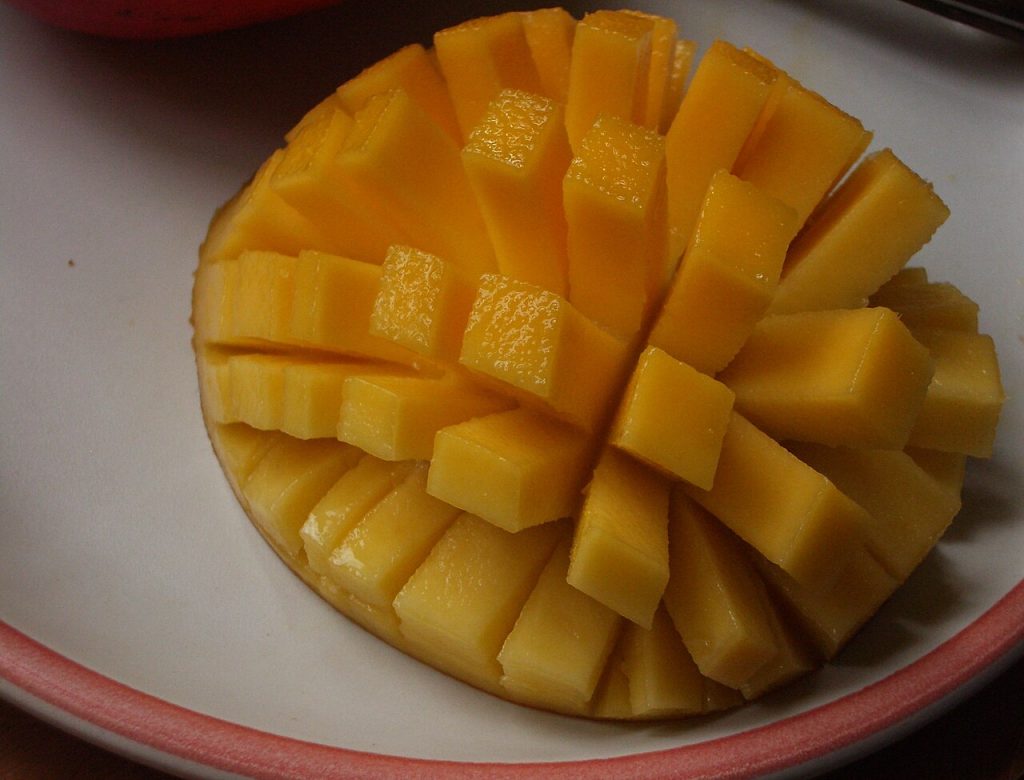
Take one cheek and hold it skin side down in your palm or on the board. With the tip of the knife, score the flesh in a crosshatch pattern, cutting down to the skin but not through it. Make the cuts about half an inch apart for bite-size cubes.
Push the skin upward from underneath so the cheek turns inside out and the cubes pop up like a hedgehog. Slice the cubes off the skin into a bowl with your knife, or scoop them out with a large spoon.
Step 3: Trim around the pit
Do not throw away the center section. Use a paring knife to cut the remaining strips of fruit from either side of the pit, then peel off the skin and cut the flesh into pieces. Or simply peel the center piece and enjoy eating the fruit straight off the pit; it is the cook’s treat.
The peeler method for slices
For long slices or spears, peel the whole mango first with a sharp vegetable peeler, just as you would a potato. Then cut off the cheeks as above and slice them lengthwise. A peeled mango is very slippery, so hold it with a paper towel or set it on a damp cloth to keep it steady. This method is great for fruit platters and salads.
Choosing and ripening mangoes
A ripe mango feels slightly soft when gently squeezed and smells sweet and fragrant at the stem end. Color is not a reliable guide, since many varieties stay partly green when ripe. Firm mangoes will ripen at room temperature in a few days; a paper bag speeds things up. Ripe mangoes can be refrigerated for up to five days.
Varieties differ. Tommy Atkins and Kent are large and common in supermarkets. Ataulfo, or honey mangoes, are smaller, golden yellow and almost fiber-free, with a thin pit that leaves more flesh.
How to use cut mango
- Blend it into a mango lassi or smoothie
- Toss cubes into a salsa with red onion, lime, cilantro and chili
- Add slices to green salads, grain bowls or fish tacos
- Spoon it over yogurt, oatmeal or chia pudding
- Freeze cubes on a tray for smoothies and frozen treats
Store cut mango in an airtight container in the fridge for up to 4 days, or freeze the cubes in a single layer, then transfer to a bag for up to 6 months. Some people are sensitive to the sap in mango skin, so wash your hands after handling the peel if you notice any irritation.
This guide is general kitchen information, not food-safety certification or medical advice. See our Disclaimer and Image Credits.